EssayApril 3, 2026
When Trade Policy Moves Faster Than Your Decision Process
The data arrives at roughly the same time for everyone.
When Liberation Day tariffs hit, every supply chain team in every multinational had access to the same information within hours. The policy change was public. The commodity impact was published. The freight disruption was on the front page.
And yet the response time varied by months.
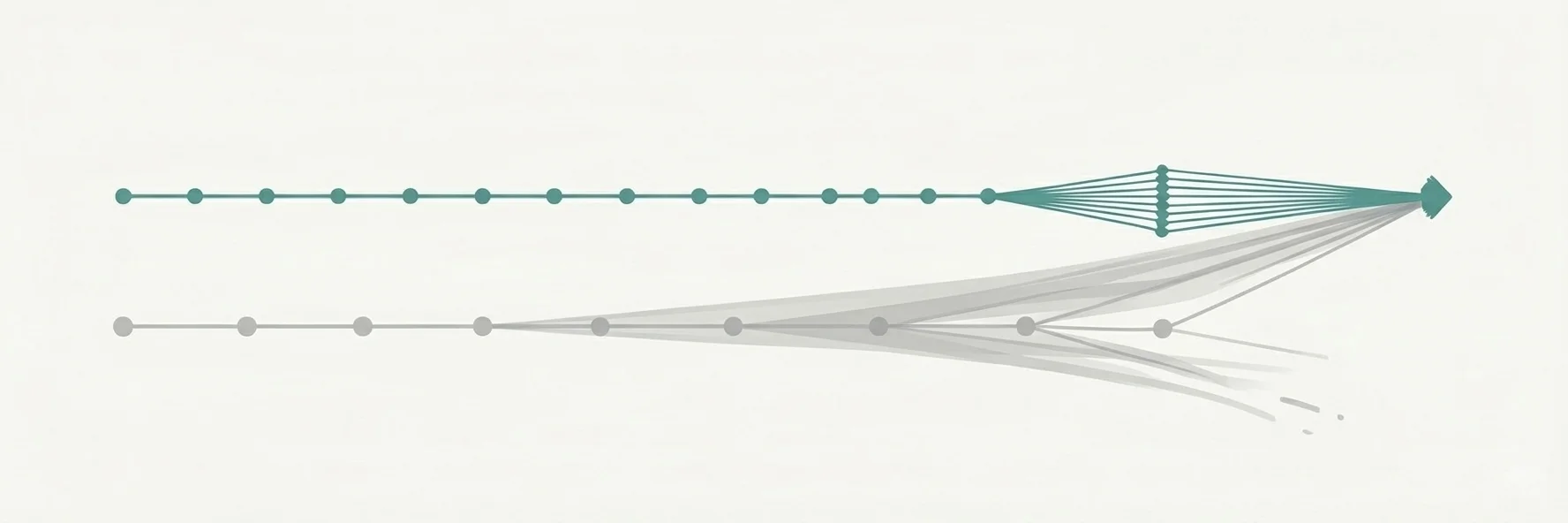
Some organisations ran scenarios in the first week: which suppliers are exposed, what are the alternative sourcing options, what does each cost, what is the deadline for locking in a position. Others are still compiling the analysis. The difference is not data access or analytical capability. It is the time between detecting a signal and arriving at a structured response.
That compression is where the value sits. And almost nobody has infrastructure for it.
The same data, different clocks
KPMG reports that 78% of supply chain leaders expect tariff disruptions to intensify in 2026. Only 25% feel prepared.
That 53-point gap is not an information gap. Every organisation has analysts, dashboards, and commodity feeds. The gap is structural: how long does it take to go from “something changed” to “here are our options, here are the trade-offs, here is what we recommend, and here is the cost of waiting another week”?
In most enterprises, that path runs through a series of meetings. Procurement talks to finance. Finance asks for data. The data sits across three systems. Someone builds a spreadsheet. By the time the analysis reaches a decision-maker, the window for the best options has closed. The conversation shifts from strategy to damage control.
The information existed at every point. What was missing was a system that compressed the time between signal and structured choice.
Why dashboards cannot do this
A dashboard shows you state: what happened, where the numbers are, which indicators are red. When trade policy changes overnight, a dashboard can tell you that something is wrong. It cannot tell you what to do about it.
The distance between “polymer prices are up 22%” and “here are four procurement responses, ranked by cost, risk, and implementation timeline, with a deadline for each” is enormous. That distance is not covered by better visualisation. It is covered by a system that connects signals to exposure to options to trade-offs automatically.
This is what a judgement graph does. It is not a dashboard that updates faster. It is a structure that maps what changed to what it affects to what you can do about it, with the cost of each path quantified and a clock running on each option.
The canary in the long tail
Most scenario planning treats the future as a distribution around a central estimate. P50 is the plan. P10 and P90 are the stress cases. This works for normal volatility.
Tariff shocks are not normal volatility. They are political decisions that create discontinuities. A 25% tariff on a component from a specific country is not a fluctuation around a mean. It is a structural shift that invalidates the distribution.
The organisations that respond fastest are not the ones with the best P50 forecast. They are the ones whose systems monitor the long tail: low-probability scenarios where the cost of being wrong is catastrophic but the cost of preparing is small. A canary system that flags “if this trade route closes, here is your exposure and here are your alternatives” before the closure happens. Not prediction. Preparation.
The signal-to-response compression is sharpest when the signal comes from the tail, because that is exactly where traditional planning is slowest to react.
What this looks like in practice
A tariff change is announced on Tuesday. By Wednesday, the system has traced it through the supply base: which suppliers are in affected regions, which products depend on those suppliers, what the cost impact is at current volumes, and what alternative sourcing options exist with their lead times and price differentials.
By Thursday, a structured set of options is on the procurement director’s desk. Not a spreadsheet someone built overnight. A set of scenarios with quantified trade-offs, ranked by total cost of ownership over 12 months, with a clear indication of which options expire when.
By Friday, a decision has been made and traced: what was chosen, what was rejected, what assumptions it depends on, and what would trigger a review.
That is four days from signal to committed, traceable response. Most organisations take four weeks to get to the spreadsheet stage. The difference in cost, in optionality, in competitive position is not marginal. It is structural.
They will still make wrong calls. Tariffs get reversed. Alternative suppliers have quality problems. But the reasoning is traced, so the next cycle starts from what was learned, not from zero. Decision quality is not about being right once. It is about being less wrong each cycle.
The April 2026 tariff environment is not a crisis. It is a sorting mechanism. The organisations that have compressed the time between signal and structured response are making decisions this week. The rest will absorb the cost and explain it in the quarterly review.
Sources
Share feedback
No public comments. If you want to share a reaction or correction, send it here.